


White Paper 01:
Offline AI Architecture and the Trilemma of Corporate Security
The integration of Generative Artificial Intelligence into the modern business ecosystem marked the beginning of a new era of productivity, but it brought with it a structural vulnerability that many organizations still ignore. During the first wave of adoption, the market succumbed to the convenience of the public cloud, neglecting the fact that corporate data is now the most valuable asset of any institution. When a company submits its strategies, proprietary code, or sensitive customer data to global language models, it is accepting a silent flight of intellectual property. In this scenario, data security ceases to be a merely technical issue and becomes a strategic imperative for survival.
This technological crossroads led to the identification of what we call the Modern AI Trilemma. Traditionally, companies were forced to balance three seemingly irreconcilable pillars: total security, absolute privacy, and high-level performance. In conventional cloud-based architecture, security and privacy are invariably sacrificed in exchange for scalable processing capacity. On the other hand, previous attempts at local processing frequently failed in performance, resulting in slow systems unable to handle the complexity of world-class language models.
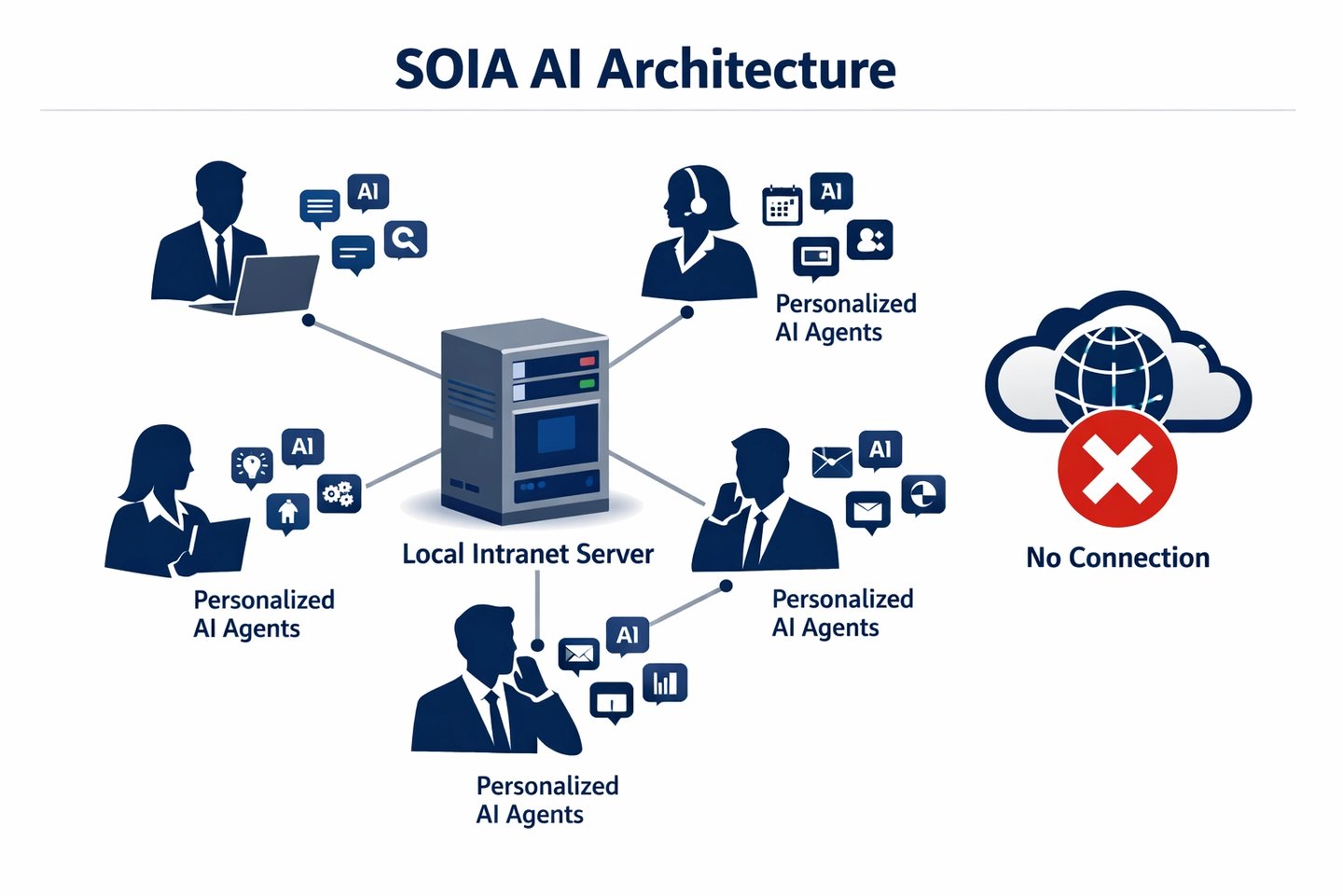
SOIA emerges to break this trilemma through the implementation of a local and native AI architecture. We believe that true digital sovereignty is only achieved when intelligence resides where the data is born: within the digital walls of the company itself. By using high-density computing hardware, such as the NVIDIA Jetson platform, we can bring the power of a data center to an edge infrastructure (Edge AI) that operates 100% offline. This approach ensures that intranet processing maintains the integrity of trade secrets, while local information libraries allow AI agents to collaborate with the human team with virtually no latency.
Ultimately, the path to the future does not lie in dependence on external servers or generic models exposed to global threats. The future demands a transition to sovereign systems, where each organization owns its own intelligence and infrastructure. By integrating digital colleagues who respect the company's physical perimeter, we transform technology from a potential vulnerability into a tool of unquestionable power. The era of offline AI is not just an alternative; It is the foundation upon which visionary companies will build their leadership in the 21st century.
Native Architecture and Digital Sovereignty, or the "Trust Engineering" of SOIA
The true innovation in enterprise Artificial Intelligence lies not only in the language model, but in the architecture that supports it. SOIA differentiates itself by being a platform built in native code, designed to operate as an intelligent resource orchestrator. Unlike generic solutions, SOIA dynamically manages multiple libraries, tools, and APIs, selecting the most appropriate computational resources based on the complexity of the task and the performance needs of each agent.
This engineering allows for unprecedented vertical and horizontal scalability in controlled environments. Whether the platform is running on an isolated intranet or connected to the network, its central engine decides in milliseconds which technical "muscles" to activate. This modularity ensures that the platform is fully customized to each client's workflow, adapting from small service operations to complex industrial or state ecosystems.
Security is implemented through overlapping layers, or Security Gates, which guarantee the total integrity of the system. The SOIA structure is organized into customized spaces for different human employees; Each user operates in an isolated and secure environment, accessing only the agents and databases specific to their functions. This compartmentalization of privileges ensures that sensitive information never passes between departments without proper authorization.
To deepen the technical understanding of our infrastructure, we analyze the pillars of the platform:
Q: What does it mean, in practice, for SOIA to use "native code" to manage libraries and APIs?
A: It means that SOIA is not merely an intermediary for external models. We have a proprietary engine that intelligently manages assets. If an agent needs to perform a complex calculation, the platform activates a local mathematical library; if they need an external market analysis (when connected), they call the specific API. This orchestration ensures that performance is optimized and that the agent always has the right tool for the job, without wasting resources.
Q: How is security guaranteed in an environment where multiple employees interact with AI?
A: Through a "Custom Spaces" architecture and multiple Security Gates. Each employee has their own work silo. The agent assisting Human Resources is not the same, nor does it have access to the same data, as the agent supporting the Engineering team. These security gates prevent unwanted data crossing and ensure that information sovereignty is maintained at each hierarchical level.
Q: Is the platform scalable within a limited local infrastructure?
A: Yes. Because it is a customized platform, SOIA is configured to grow with the company's needs. Our native code allows for efficient memory and processing management, enabling the addition of new agents and expansion of knowledge libraries without the need to restructure the entire client network. It is a solution that is tailored and scales with the business.
Q: What is the advantage of having specific agents for each employee instead of a centralized AI?
A: Specificity generates precision. A generalist agent makes mistakes due to an excess of irrelevant information. At SOIA, agents are trained and equipped only with the tools necessary for the user's role. This not only increases productivity but also reinforces security, since each agent's scope of action is strictly limited by their original purpose.


SOIA - Artificial Intelligence Organizational System Private AI | Human Collaboration


AI-powered platform. Transform market chaos into structured clarity with real-time analytics and automated insights..
© 2026 SOIA. All rights reserved